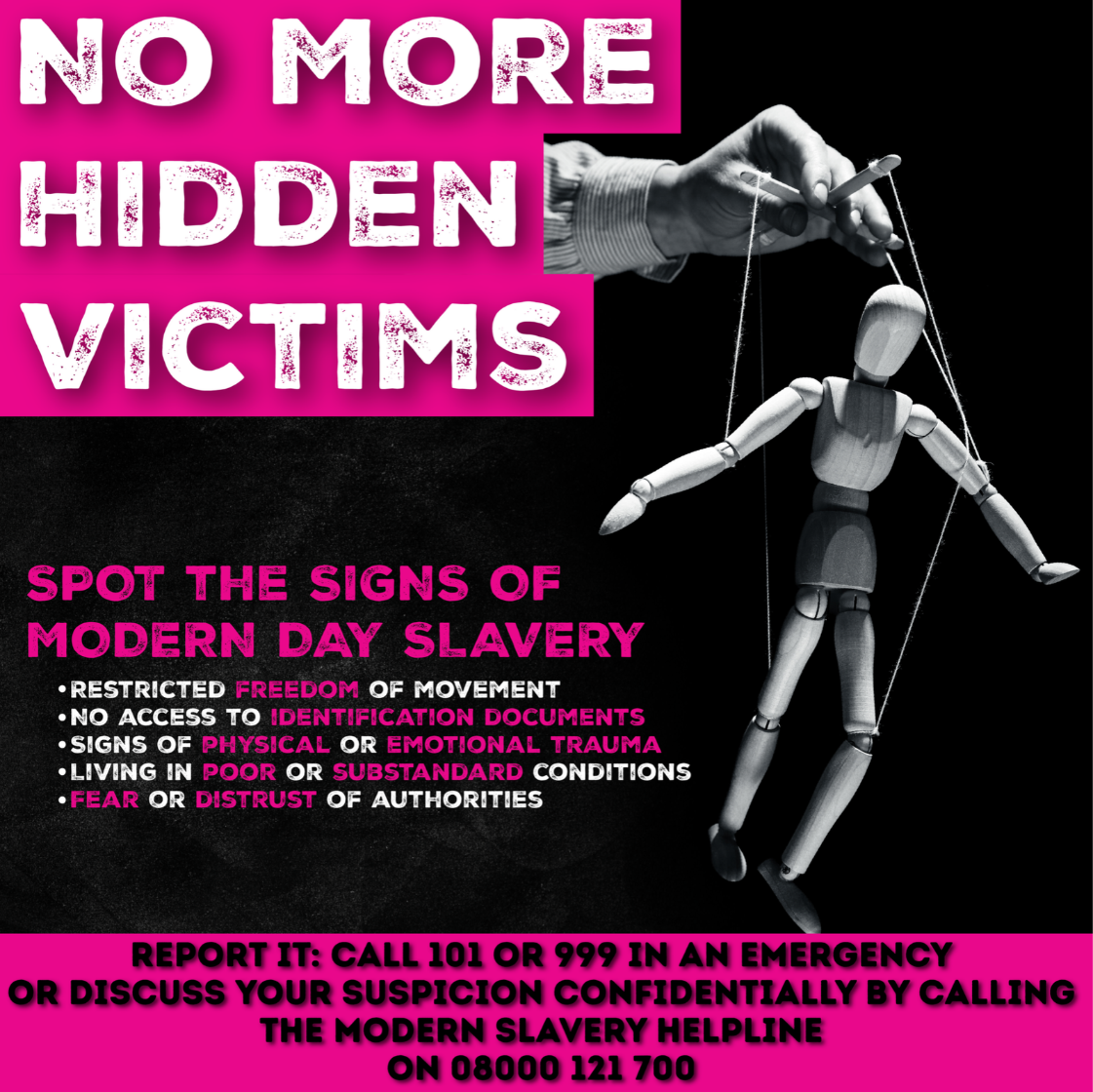
Issued by Humberside Police
Officers in our Modern Slavery and Human Trafficking (MSHT) team are cracking down on slavery and human trafficking in our area, and your information could prove crucial in helping protect those who are potentially being exploited or forced into work.
Working in collaboration with the Humber Modern Day Slavery Partnership consisting of Detective Sergeant Richard Kirk who heads up our MSHT team, modern slavery leads from Hull City Council, East Riding Council, North, and North East Lincolnshire Council, as well as a specialist employed by the University of Hull, together we share information that enables us to build a bigger picture around the offending and act upon it through conducting multi-agency intensification periods where we relentlessly target areas of most concern.
Everywhere that is targeted is derived from evidence-based data that we collectively retrieve in an effort to tackle all the crimes associated with modern slavery and human trafficking to safeguard victims and hold those accountable for their crimes.
We also work alongside other key partners such as organised immigration crime teams, housing authorities, the labour abuse authority, and environmental health, as often there are multiple touch points when we do come across incidents where crimes of this nature are in play.
DS Richard Kirk of our MSHT team said: “Modern day slavery and human trafficking are often unseen crimes that go unnoticed in our local communities.
“Whether that’s at a local hand car wash, a nail bar in town, a village takeaway, or even a popular restaurant – slavery and trafficking is a growing cause for concern across our entire force area.
“Whilst this is all business as usual for the staff and officers that sit within the MSHT team, we are hoping our support of Anti Slavery Week will bolster awareness and education around what to look out for when visiting these businesses and ultimately encourage people to report any suspicious activity to us.
“Through the Humber Modern Day Slavery Partnership, our objective is to safeguard people from slavery and human trafficking and to raise awareness that in some instances people are being forced into providing free labour against their will, and for the financial benefit of others.
“This is happening in businesses right across our force area and causes immense misery.
“Someone is classed as a victim of slavery if they are:
- Forced to work through mental or physical threat
- Owned or controlled by an ‘employer’, usually through mental or physical abuse or the threat of abuse
- Dehumanised, treated as a commodity, or bought and sold as ‘property’
- Physically constrained or have restrictions placed on their freedom
“There is no standard victim profile for modern day slavery.
“Victims can be men, women, and children of all ages, but it is normally most prevalent amongst the most vulnerable – including minority groups or those who are socially excluded.
“In our force area, contrary to what some people may believe, we do find that the highest percentage of people who are victims of these kind of crimes and are being exploited are actually from the UK.
“Sadly, most of these are victims of Child Sexual and Criminal Exploitation through County Lines and other organised crime networks.
“Car washes, restaurants, takeaways and nail bars are often on streets and within communities surrounded by unwitting families, residents and visitors.
“However, some of those neighbours and people who frequent these locations might have noticed something that is not quite right but may be unaware that what is actually going on behind closed doors is slavery or human trafficking.
“We would encourage anyone who has suspicions to report them to us on our non-emergency number 101, 999 in an emergency, or independent charity Crimestoppers on 0800 555 111 if you wish to remain anonymous.
“There is also a dedicated Modern Slavery Helpline too on 0800 0121 700, or visit the website for more information.
“This specific intelligence allows us to target businesses directly and safeguard all those involved and together with the assistance from our communities, we can help protect the most vulnerable people in our communities.”
The most common forms of modern slavery and human trafficking are:
- Sex trafficking: predominantly women forced to provide sexual services, phone sex lines, internet chat rooms, escort agencies
- Forced labour: working for low pay, or no pay, in poor conditions with threats of punishment
- Domestic Servitude: working at their employer’s home for low pay, or no pay, where they’re often abused and can’t leave
- Forced marriage
- Forced crime: begging, pick-pocketing, selling drugs, bag snatching
- Organ harvesting: trafficking people to sell their organs for transplant
There are several signs which could indicate modern slavery or human trafficking is at work, and the MSHT teams encourage you to stay vigilant and know how to spot them:
- Suffering from physical or psychological abuse, appearing withdrawn and looking dishevelled
- Never seen travelling alone
- Avoiding eye contact and seeming reluctant to have a conversation
- Appearing fearful of authorities in particular law enforcement
- Seeming unfamiliar with the neighbourhood in which they are living and working
- Living in overcrowded accommodation
- Having very few personal possessions
- Having no access to personal ID documents
- Being dropped off and collected at work every day – either very early, or very late
- Seemingly being under the influence of other people